> ## Documentation Index
> Fetch the complete documentation index at: https://docs.entire.io/llms.txt
> Use this file to discover all available pages before exploring further.
# Inspect a Session
> Browse transcripts, tool calls, file diffs, and AI attribution for an AI coding session
A **session** is the complete record of an AI coding interaction — every prompt, response, tool call, and file change. Entire.io lets you browse sessions, see exactly what an agent did, and understand who contributed what.
## How sessions and checkpoints relate
Sessions and checkpoints have a many-to-many relationship that mirrors how you actually work:
| Scenario | How it looks in Entire |
| --------------------------------------- | ---------------------------------------------------------------------------- |
| One session, one checkpoint | Most common. You ask the agent to do something, it does, you commit. |
| One checkpoint, multiple sessions | Several sessions worked toward a single feature; you commit once when done. |
| One session, multiple checkpoints | A long-running session produced multiple commits over time. |
| Multiple sessions, multiple checkpoints | Multiple terminals + multiple commits. Entire matches them up automatically. |
## Where sessions live
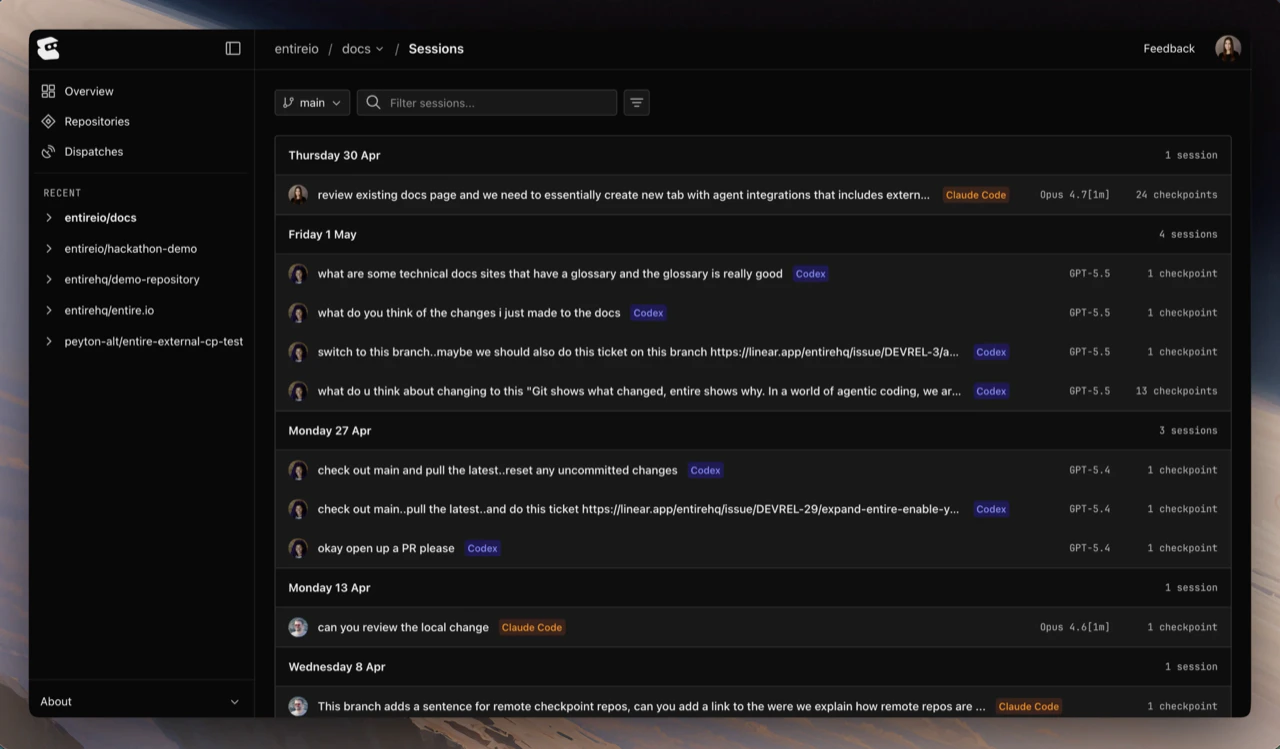
Sessions appear inside the **Sessions** tab on a checkpoint detail page. Each row shows the agent (Claude Code, Codex, etc.), a step count, the opening prompt, and a relative timestamp.
Click a session to open its timeline alongside the list.
## Session timeline
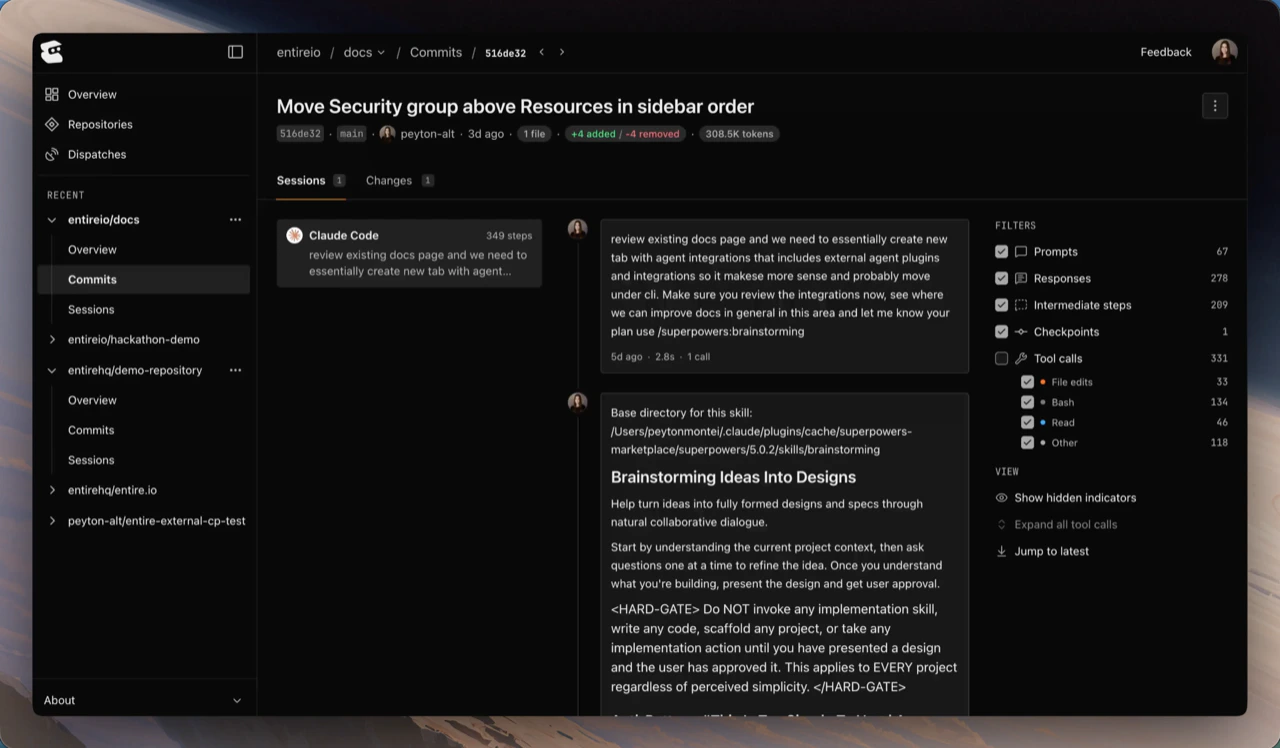
The session timeline is the heart of the session view. It shows the conversation in order — prompts, agent responses, expandable tool calls, and runtime tags — with a metadata panel summarizing the session.
The metadata panel surfaces:
* **Model** — which model the agent ran on (e.g., Opus 4.7, GPT-5.5)
* **Duration** — how long the session lasted
* **Tokens** — total tokens consumed by the session
The filters rail on the right lets you toggle what's visible in the timeline: prompts, responses, intermediate steps, checkpoints, and tool calls (broken down into file edits, bash, read, and other).
## File diffs
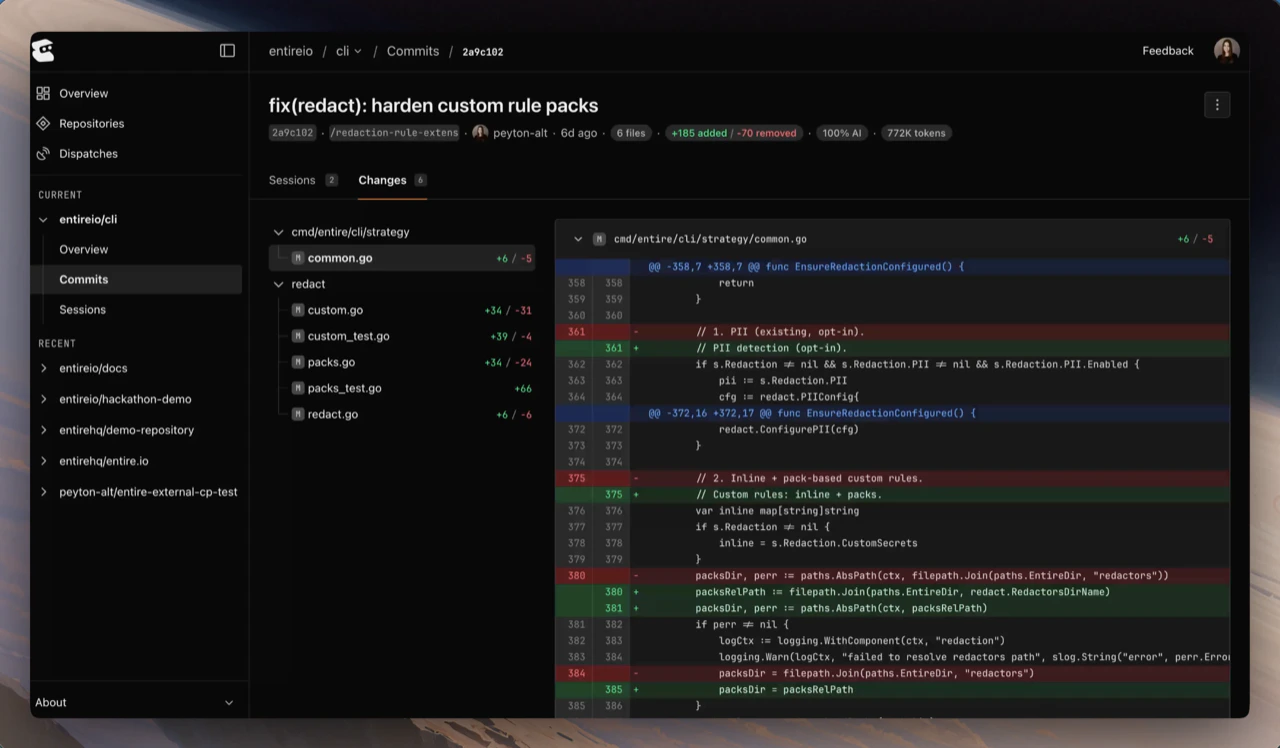
Files modified during a session live on the checkpoint's **Changes** tab. Open the checkpoint that owns the session to see the full diff — file tree on the left, side-by-side or unified diff on the right.
When a checkpoint groups multiple sessions, the diff shows the combined change. The per-session contribution surfaces through the [AI attribution](#ai-attribution) breakdown below.
## AI attribution
Entire calculates how much of a checkpoint came from the agent versus a human edit. The percentage appears as a badge on the checkpoint header, with a finer breakdown per session.
The breakdown counts:
* **Agent lines** — lines the agent committed
* **Human added / modified / removed** — lines you edited directly
* **Agent percentage** — the rolled-up share for the session, surfaced as the badge on the checkpoint header
AI attribution helps during code review — reviewers see at a glance how much of a change came from the agent versus a human edit, and can dig into the transcript when something needs context.
## Sub-agent sessions
When an agent spawns sub-agents (for example via Claude Code's `Task` tool), Entire captures each as its own session and rolls their tokens up into the parent checkpoint's totals. Sub-agent sessions appear alongside the parent in the checkpoint's **Sessions** tab.
Open any sub-agent session to see its own transcript and tool calls.
## Linking to commits
Every session is linked to one or more Git commits via the `Entire-Checkpoint` trailer. From a session you can:
* Open the [checkpoint detail view](/web/review-checkpoint#checkpoint-detail) for any commit the session touched
* Open the underlying commit on GitHub from the checkpoint header's actions menu
## Continue with
Resolve missing-session and sync issues.
See file diffs, metadata, and how to link from a commit or PR.
 Click a session to open its timeline alongside the list.
## Session timeline
The session timeline is the heart of the session view. It shows the conversation in order — prompts, agent responses, expandable tool calls, and runtime tags — with a metadata panel summarizing the session.
Click a session to open its timeline alongside the list.
## Session timeline
The session timeline is the heart of the session view. It shows the conversation in order — prompts, agent responses, expandable tool calls, and runtime tags — with a metadata panel summarizing the session.
 The metadata panel surfaces:
* **Model** — which model the agent ran on (e.g., Opus 4.7, GPT-5.5)
* **Duration** — how long the session lasted
* **Tokens** — total tokens consumed by the session
The filters rail on the right lets you toggle what's visible in the timeline: prompts, responses, intermediate steps, checkpoints, and tool calls (broken down into file edits, bash, read, and other).
## File diffs
Files modified during a session live on the checkpoint's **Changes** tab. Open the checkpoint that owns the session to see the full diff — file tree on the left, side-by-side or unified diff on the right.
The metadata panel surfaces:
* **Model** — which model the agent ran on (e.g., Opus 4.7, GPT-5.5)
* **Duration** — how long the session lasted
* **Tokens** — total tokens consumed by the session
The filters rail on the right lets you toggle what's visible in the timeline: prompts, responses, intermediate steps, checkpoints, and tool calls (broken down into file edits, bash, read, and other).
## File diffs
Files modified during a session live on the checkpoint's **Changes** tab. Open the checkpoint that owns the session to see the full diff — file tree on the left, side-by-side or unified diff on the right.
 When a checkpoint groups multiple sessions, the diff shows the combined change. The per-session contribution surfaces through the [AI attribution](#ai-attribution) breakdown below.
## AI attribution
Entire calculates how much of a checkpoint came from the agent versus a human edit. The percentage appears as a badge on the checkpoint header, with a finer breakdown per session.
The breakdown counts:
* **Agent lines** — lines the agent committed
* **Human added / modified / removed** — lines you edited directly
* **Agent percentage** — the rolled-up share for the session, surfaced as the badge on the checkpoint header
When a checkpoint groups multiple sessions, the diff shows the combined change. The per-session contribution surfaces through the [AI attribution](#ai-attribution) breakdown below.
## AI attribution
Entire calculates how much of a checkpoint came from the agent versus a human edit. The percentage appears as a badge on the checkpoint header, with a finer breakdown per session.
The breakdown counts:
* **Agent lines** — lines the agent committed
* **Human added / modified / removed** — lines you edited directly
* **Agent percentage** — the rolled-up share for the session, surfaced as the badge on the checkpoint header